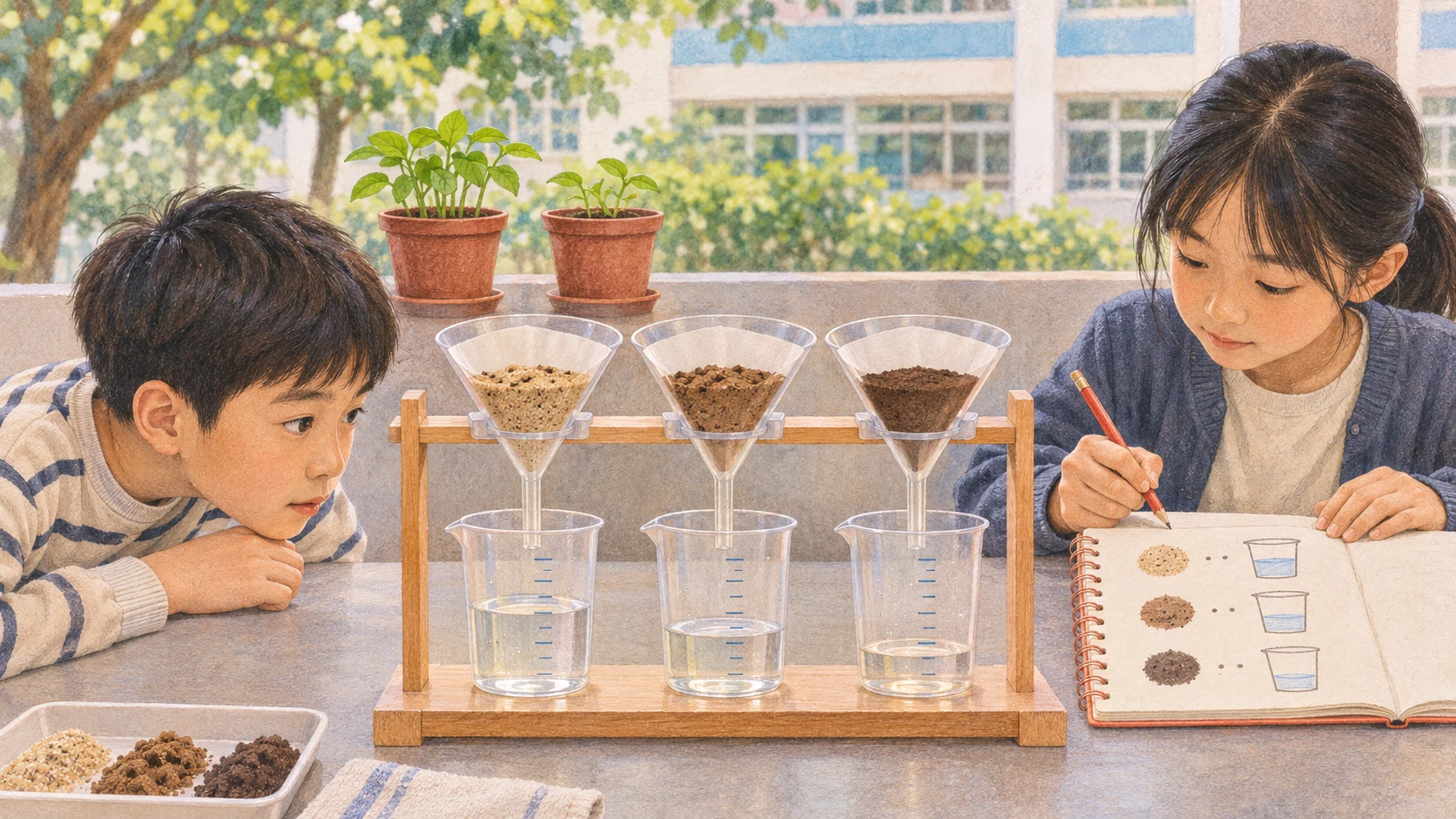
Imagine two pots of the same kind of plant in a school's planting corner. One has leaves spreading out; the other looks sparse. The child checks the watering log and says: "They clearly got the same amount of water every day. Could it be the soil?"
This is a guess worth keeping.
But the two pots may sit in different places, and they may not have started out the same size. Looking only at the difference in front of us, we cannot yet tell which condition made the difference.
This is where science learning adds a step: how do we arrange a comparison so that the results really help answer the question?
EvoClass's SCI401-HK Hong Kong Primary 4 Science Course covers topics including soil, plants, materials, energy, Earth and space, and engineering design. The soil water-retention activity offers a concrete entry point: narrow the question first, then let the guess meet observation.
First, turn the "why" into a question that can be compared
"Why do the two plants grow differently?" involves many conditions. If soil, light and amount of water are all changed at once, it is hard to tell what caused any change in the plants, even if changes appear.
We can start with just one question: under agreed test conditions, what difference is there in how much water different soils hold?
Lesson 3, "Soil Secrets and Plant Reproduction", discusses the properties of sand, loam and clay alongside fair testing. In this kind of comparison, we need to identify the condition we want to change, the conditions we try to keep the same, and the result we plan to observe or measure.
This approach also appears in the Hong Kong Education Bureau's Science (Primary 1–6) Curriculum Guide (2025): inquiry skills for Primary 3 to 4 include, with teacher guidance, identifying the factors to investigate, to measure and to keep unchanged, as well as recording evidence and explaining results.
For a child, the first step can be put very simply: this time we want to compare types of soil, so the other conditions that could affect the reading need to be arranged carefully.
Once the question is smaller, judgement has something to hold on to.
The water flows out, but the reading is easy to reverse
The course's "Soil Water-Retention Challenge" uses funnels, filter paper and measuring cups to turn differences in water retention into an observable phenomenon.
Different soils are placed in identical funnels, with soil volume, filter paper conditions and the amount of water added kept the same, and then the water that flows out is measured. In practice, we should also note the initial moisture of each sample and agree on the same observation time, so that readings have a basis for comparison.
Here is a point where it is easy to pause and discuss: the measuring cup collects more water—what does that mean?
The water in the cup is water that has already flowed out. If it is treated as the water the soil retained, the observation gets read backwards. Children need to follow where the water goes and reinterpret what they see.
Recording therefore matters. Children can write down each sample, the measuring time point and the amount of water that flowed out, expressing readings in millilitres rather than only noting "this one had a bit more, that one a bit less."
If results differ from expectations, there is still something to do: check for spills, whether filling was consistent, whether the filter paper was blocked, and then consider how to repeat the comparison. When testing repeatedly, keeping every reading is more helpful than picking out only the one that matches expectations.
Back with the plants, more questions follow. This small test can offer clues about how soils behave in retaining water; how a plant grows is also related to drainage, nutrients, light and other conditions. The fact that one sample let less water through does not mean it suits every plant.
From a pot of soil to an everyday object
After getting to know soil, "how properties affect use" can carry on into daily life.
The metals and non-metals content in Lesson 1 links properties such as heat conduction and electrical conductivity to everyday objects.
A pot body, for example, needs to pass heat to the food, while the handle is meant to slow the transfer of heat to the hand. Different parts of the same object take on different tasks, so the reasons for choosing their materials differ too.
This has something in common with choosing soil for a plant: first state what need must be met, then discuss which property helps.
A child can pick a familiar object, point out two of its materials, and try to explain why the designer combined them that way. Where something still cannot be explained clearly, it can be kept as a question for the next observation.
Names such as "metal," "non-metal," "sand" and "clay" thus gradually become connected to uses and reasons. Beyond classification, children begin to have explanations of their own.
After making something, how can it be improved?
When children try to solve a small problem, the method of comparison finds a new use.
Lesson 10, "Natural Ecosystems and the Engineering Design Cycle" includes stages such as identifying a need, gathering information, drawing sketches, making, testing and improving, and also offers a design scenario for an eco-friendly pencil holder.
The task can be made smaller: use a recycled cardboard box to make a pencil holder that holds stationery steadily. First draw the shape and the base, then decide how to judge whether it is stable enough.
When comparing two designs, put the same set of stationery into each, arrange and test them in the same way. If one tips over easily, check the base, the centre of gravity and the material joints, choose one thing to adjust, and note the reason for the change.
When a piece does not meet expectations, that test still leaves information behind. There is then a basis that can be explained for why the next version was changed in a certain way.
Here science inquiry and engineering design connect: the former helps us understand phenomena, the latter tries to meet a need; observation, measurement and evidence keep both moving forward.
For teachers and parents who want to explore everyday things with their children, the SCI401-HK course overview offers a further entry point for choosing topics. You can start with the soil activity, sit with your child to write down one guess, and then discuss together how to compare.
The two plants in the planting corner may not yet have a full explanation.
But the child can already point to the record and say: "This is what I observed; these conditions haven't been compared yet. Next time, I want to try this one first."
An everyday question has, in this way, grown its next step.
The course description is based on current EvoClass courseware; the background on inquiry skills refers to the Education Bureau curriculum guide. The planting corner, measurement records and simplified pencil holder task described here are teaching scenarios or activity suggestions, not documented test cases or records of learning outcomes. The teaching materials at the lesson links in this article are primarily in Traditional Chinese.