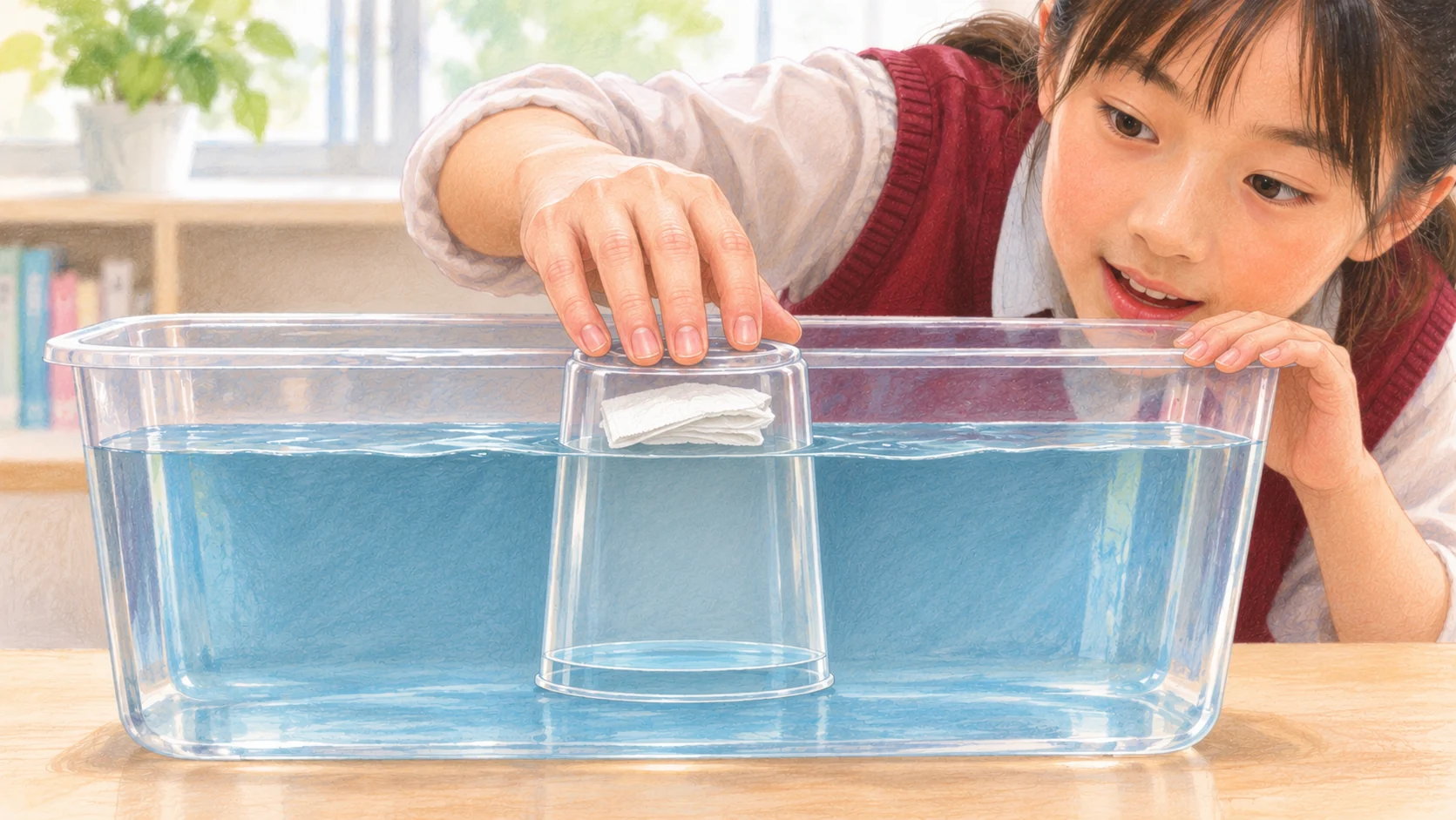
If you push an upside-down cup straight down into water, why doesn't the water immediately fill the inside of the cup? And if you slowly change the angle of the cup, where do the bubbles escape from?
This small phenomenon is a good one to let children guess about first. The cup looks empty, but "I can't see anything" and "there is nothing inside" are actually two different judgments.
EvoClass's SCI501-HK Hong Kong Primary Five Science Course moves gradually from the human body and air to topics such as landforms, fossils, energy, sound, and Earth and space. Among the current ten lessons, one thread worth following is: when something cannot be seen directly, how do we explain it from the effects or traces it leaves behind?
What occupies the space inside the cup first
In Lesson 2, "The Power of Air and the Shaping of the Land", the course first discusses how air occupies space and has weight, then moves on to wind, atmospheric pressure, and the shaping of landforms.
The upside-down cup is one starting point for observation. When the cup is pressed into the water with its mouth facing down, the air inside is trapped; as conditions such as the depth of immersion change, the air may also be compressed. Change the angle of the cup, and the air can leave in the form of bubbles, allowing water to enter more of the space.
Here, it helps to separate what is seen from what is inferred. What is seen is how much water entered and whether there were bubbles; only on the basis of these phenomena do we go on to explain that there is air inside the cup and that air occupies space. Don't be in a hurry to jump over the observations in between with a single conclusion.
Activities like this are suitable for plastic containers and should be done under adult supervision. This article uses it only to illustrate a way of observing; the specific steps and explanations can be learned step by step alongside the course materials.
After air enters the body, the questions go further inward
Breathing happens every day, but where does the air we breathe in go? Why does breathing speed up after running? These familiar experiences likewise require knowledge of body systems to understand.
Lesson 1, "The Wonders of the Human Body System and the World of Gases" connects the body's systems with air, introduces the basic structure and functions of systems such as the respiratory and digestive systems, and also reminds learners to distinguish air from the oxygen within it.
You can start by drawing a route: which parts does air pass through, and how does oxygen take part in the body's activities? Then add food, nutrients, and the energy needed for activity to the discussion. In this way, organ names gradually become an interconnected process.
For primary school learning, being able to explain clearly "which part is doing what" helps children keep asking questions more than memorizing many names at once. When a step is unclear, go back to the diagrams to look for clues.
How a fossil becomes a clue to the past
The air in a cup can be observed by changing conditions, but ancient environments cannot be placed before our eyes again. Scientific explanation therefore needs another kind of evidence: the traces that have been left behind.
Lesson 3, "The Code of Fossils and the Contributions of Scientists" discusses how we learn about past life and environments from the remains and traces of ancient organisms in rocks.
Seeing a fossil of a marine organism can lead to the explanation that this area may have had a marine environment in the past. But we also need to check the position of the fossil, the surrounding rock layers, and other evidence. One discovery provides a clue; further observation helps us judge how large a conclusion that clue can support.
In the same way, when discussing the order of rock layers, we should also note whether the layers have been overturned or affected by other geological processes. Keeping these conditions in mind helps children gradually understand that inferences have grounds, and also points that still need to be checked.
From air to sound, asking how effects happen
Sound is invisible too. How is it produced, and how does it travel from a sound source to our ears?
Lesson 7, "The Mystery of Sound and Energy Conversion" links energy conversion, vibration, the medium of transmission, and pitch, and extends to hearing protection.
When studying, try drawing a simple process: what object is vibrating, through what medium it travels, and finally how it is heard. Then use this process to explain a familiar sound around you and see which link is still missing.
Several kinds of topics are connected in this way. Air shows its effects by occupying space, body systems are linked through processes, fossils leave traces of the past, and sound leads us to look for the relationship between vibration and transmission.
On the SCI501-HK course page, you can start from the phenomenon that interests your child most and then return to the corresponding lesson. More worth taking away than remembering "there is air in the cup" is being willing, the next time you face an unfamiliar phenomenon, to ask one more question: what observation can support this explanation?
This article is based on EvoClass's current course overview and course materials; the source material is mainly in Traditional Chinese, and lesson links follow the current access parameters. The discussion suggestions in this article do not indicate that classroom experiments have been carried out or that learning outcomes have been verified; the course description on EvoClass does not constitute official textbook authorization or official endorsement.