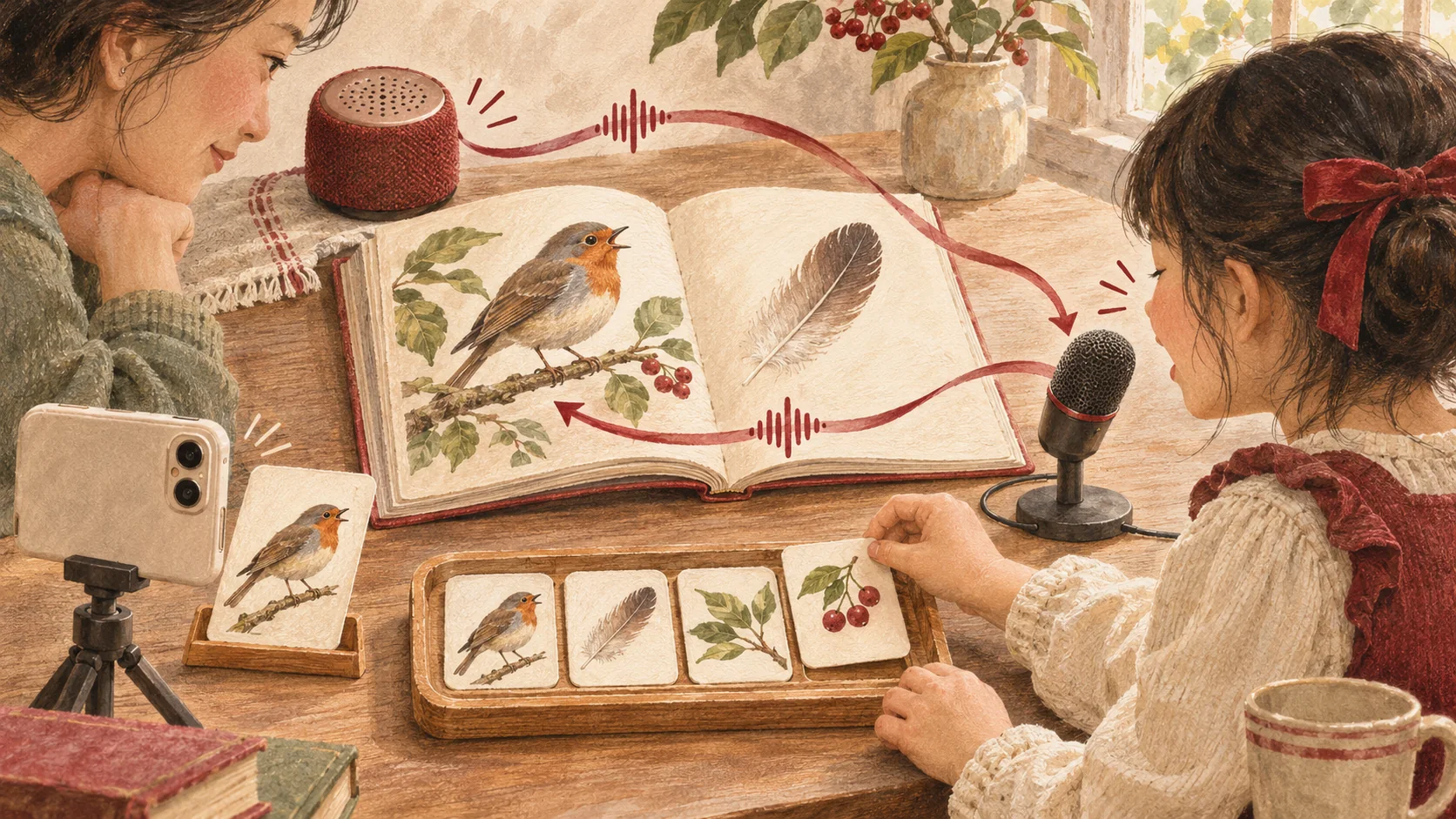
Imagine a child pointing at a picture of a bird and reading an English sentence aloud along with the model audio. When the reading ends, the room goes quiet.
What was clear this time, and what would you like to try again? Will the word you just met in the book still be findable tomorrow?
English practice needs to connect one attempt to the next. This article reviews the EvoClass textbook shadowing and personal word book updates as of November 7, 2026: model audio, recording playback, pronunciation scoring and vocabulary organization. The features are not yet available in all courses and accounts; please rely on the entry points actually provided within your course.
Hearing the model, and hearing yourself
Model audio provides a reference, but learners also need to know what they actually said.
In English textbooks that have this capability enabled, learners can play the model audio, attempt a recording, and listen back to their own voice. Practice therefore gains something to compare: the model they heard, and what they just produced themselves.
On first use, it is best to choose a short word or a short sentence, confirm microphone permissions and recording quality, and then move on to longer content. Background noise, the device and the distance from the microphone all affect recordings; an unclear recording does not necessarily reflect a learner's true pronunciation.
The value of feedback lies in helping decide how to practice next time
Pronunciation scoring adds a feedback entry point to recordings, and the related service can provide word-by-word feedback to help learners check the places that need attention.
The score itself is not the end point of practice. A more useful next step is to pick one word worth replaying, compare it with the model, and try again — rather than only trying to push the total score higher.
Automated feedback has limits too. Recording conditions, recognition results and accent differences can all affect the judgment; it should not replace a teacher's explanation, and a single result should never be used to pin a fixed ability label on a child. When feedback does not match what you actually hear, you can listen back, re-record, and then check together with a teacher or parent.
Keeping the words met in class for continued use
Vocabulary learning often breaks off between contexts: a word just met in class cannot be found once you move to another lesson; a set of words photographed on paper has to be organized all over again.
At this stage, the personal word book is connected to the learning center, so new words from textbooks can enter a personal vocabulary list. The word book is organized by personal account and can carry vocabulary from different courses, without having to build a separate, disconnected record for every textbook.
The word book also supports photographing words for recognition, selecting the words to keep, checking the definitions, and then adding them to later practice. Recognized content still needs human confirmation: not every word that appears in an image is necessarily worth saving, and automatic recognition and definitions may also need correction.
A genuinely useful word book can be very small. Start by keeping just a few words you actually met this week and are not yet familiar with, then try reading them aloud in their original sentences — this makes the next action easier to form than continually increasing the number of saved items.
From one recording to the next time you speak
This update connects several capabilities together: listening to the model, attempting to speak, listening back and reviewing feedback, and then keeping the words that need further study. It provides a continuous entry point for English practice, without promising that a single recording can judge all of a learner's language ability.
The personal vocabulary list and practice require signing in; recording requires permission to use the microphone, and uploading and scoring also depend on the entry points provided by the current course and account. If you do not see the relevant entry points for now, this should not be understood as meaning that all English courses will automatically have this capability.
You can first read the ENG005 Science-Themed English Course Guide to learn about the course's reading content, then sign in to the Learning Center to view your own learning and word book entry points. For teachers and parents, a small goal that makes a good start is: hear one sentence clearly, read one sentence aloud, and keep one word you want to use next time.