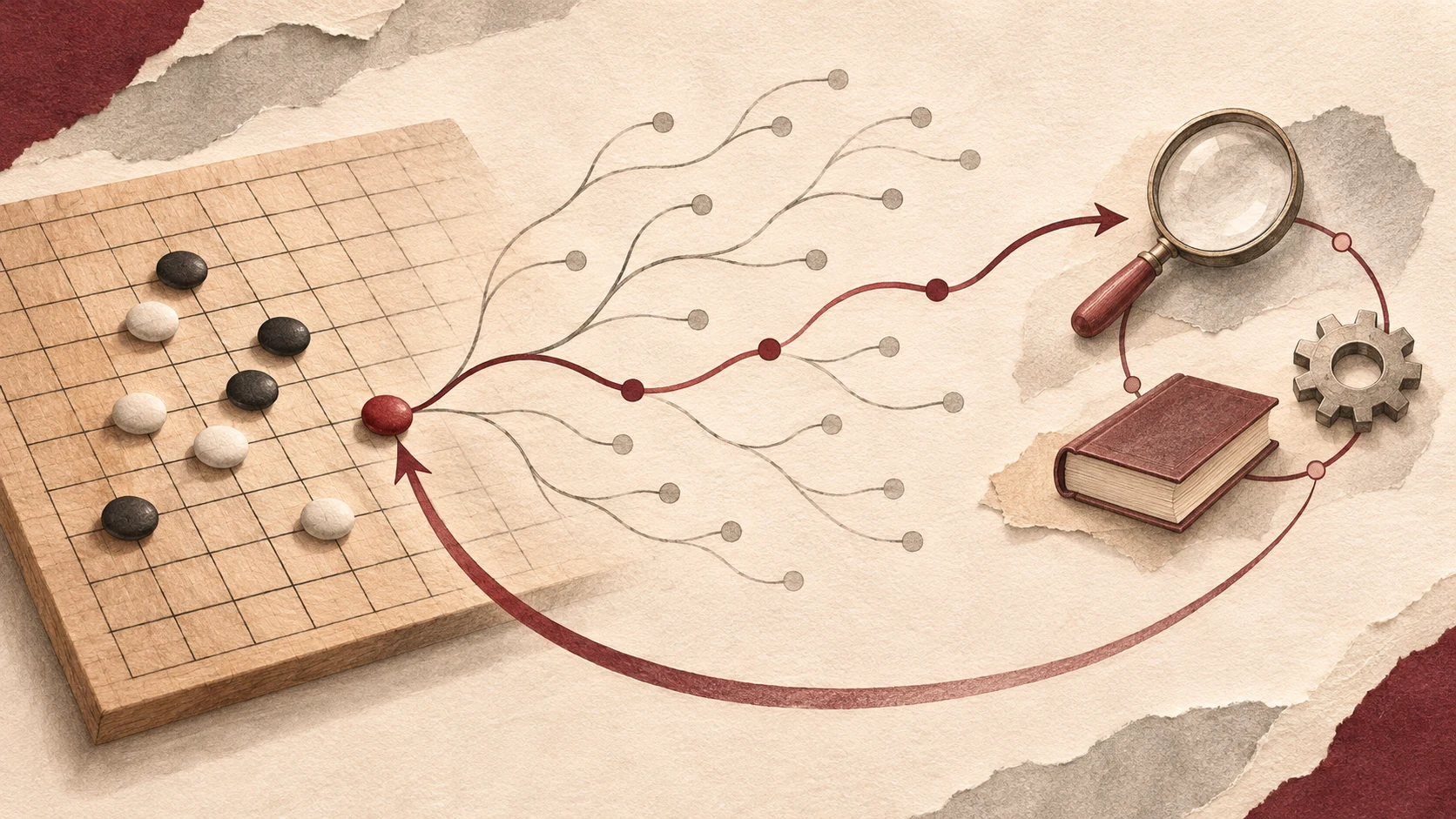
Imagine you are writing a move-selection strategy for a Gomoku program. The rules are clear and the board displays correctly; all that seems left is to let it pick the best move. But once you start reasoning ahead, every opponent response opens up more variations. Before a single stone is placed, the computation time has already run out.
This small dilemma brings up an important question in artificial intelligence: when information, time and computing resources are all bounded, how does a system make a well-founded choice? For people already used to working with AI tools, tackling a problem like this is also a chance to get closer to the inside of the technology.
PolyU's COMP5511 Artificial Intelligence Concepts revolves around search, knowledge representation, reasoning and machine learning. In the current EvoClass course materials, the learning path extends further to Transformers, large language models and agents. Starting from the board, you meet different tasks along the way and keep revisiting the same question: how is a choice made?
Before the first move, learn to trade off
If every possibility were worth computing, the program would quickly sink into a vast search space. To place a stone within a limited time, it must decide which positions to consider first, what criteria to evaluate them by, and how far to search before stopping.
A problem that looks like merely "not being fast enough" thus becomes a choice of method.
In Search Strategies: Uninformed and Heuristic Search, learners can compare different ways of exploring; by Adversarial Search and Constraint Satisfaction, they also have to fold the opponent's choices into their own judgment. Looking further ahead, how to evaluate a position, and how to cut unnecessary computation all take on concrete meaning.
The Gomoku experiment in the course offers a window for observation. Change one strategy, run the program, and compare the moves and the time taken. A move that looks advantageous now may leave an opening later; searching deeper also costs more computation.
Only when the code actually runs do the trade-offs behind an algorithm's name become visible. Learning also gains a clear handle: explain this choice, and find a way to test the explanation.
Swap in a handwritten image, and the problem changes
The rules for placing a stone in Gomoku can be written down explicitly, but the appearance of a handwritten digit is hard to specify one by one. One person writes a "3" round, another flat, and someone else's strokes almost merge together.
Adding more rules may handle a few samples in front of you, but new handwriting styles will still appear. The task thus turns in another direction: give the model data and let it learn patterns that can be used for recognition.
But having learned a batch of samples does not mean being able to handle every new case.
The COMP5511 lab materials on EvoClass include handwritten digit classification, while the lectures move from traditional machine learning into neural networks and computer vision. A small exercise worth doing is to keep a few misclassified cases, observe what the model mistook them for, and then go back to the data and the methods to look for the reason.
Following this path into Sequence Modeling and Transformers, the focus shifts further to sequences and context. When you later study large language models, the familiar chat interface will have technical threads behind it that you can keep pulling on.
Next, the course pushes the question beyond the screen: if an answer can only be completed through an actual operation, how should the system proceed?
After the answer, there is still an action
Looking up a piece of information, running a snippet of code, or continuing a task based on returned information all require the system to connect with external tools. Once a plan is generated, it still has to send a request, read the result, and judge whether the next step remains reasonable.
The agent and tool-calling practice in Lab 11 brings learners to this stage: connect a language model with external tools and observe how thinking, action and feedback form a continuous process.
At this point, attention can go to a step that is easily overlooked — how the system actually uses a tool's result after it has been returned. The returned content may be incomplete, and an operation may fail; retrying, switching methods or stopping all need a corresponding basis.
The problem from the opening board reappears in another form. One choice changes the current situation, and the next judgment must take that change into account.
Search programs and language models work by different mechanisms. Placing them on the same learning path lets you practice one way of observing that runs throughout: first clarify the task, then see how the system acts, and finally use the results to check the original judgment.
Turn one experiment into your own judgment
When systems begin to affect real tasks, running successfully also has to be considered alongside reliability, bias and the boundaries of use. AI Ethics, Safety and Alignment brings these questions into the course, placing technical implementation and human responsibility in the same picture.
Studying this course, you can set yourself a very small task: before running an experiment, write down what you expect; after seeing the results, record one place where they differ from your expectation; then return to the relevant lecture unit and try to explain the difference.
That difference might be an unexpected move, a misidentified image, or a piece of tool feedback the agent ignored. It gives direction to the next round of learning, connecting the concepts in each chapter with your own observations.
On the EvoClass COMP5511 course page, you can build a knowledge thread through the lecture units, then move into the labs and bring your questions back with you; or pick a topic that interests you first and check your understanding with simulation exercises.
Return to that game of Gomoku, and the program still has to choose its next move within a limited time. By now you have more ways to examine it: see how the search unfolds, see what the evaluation is based on, and see whether the results support the original design.
Understanding AI can start with a single stone.
Basic course information follows the official PolyU course description; specific chapter and lab descriptions are based on the current EvoClass course content. The lecture links in this article point to English learning materials.