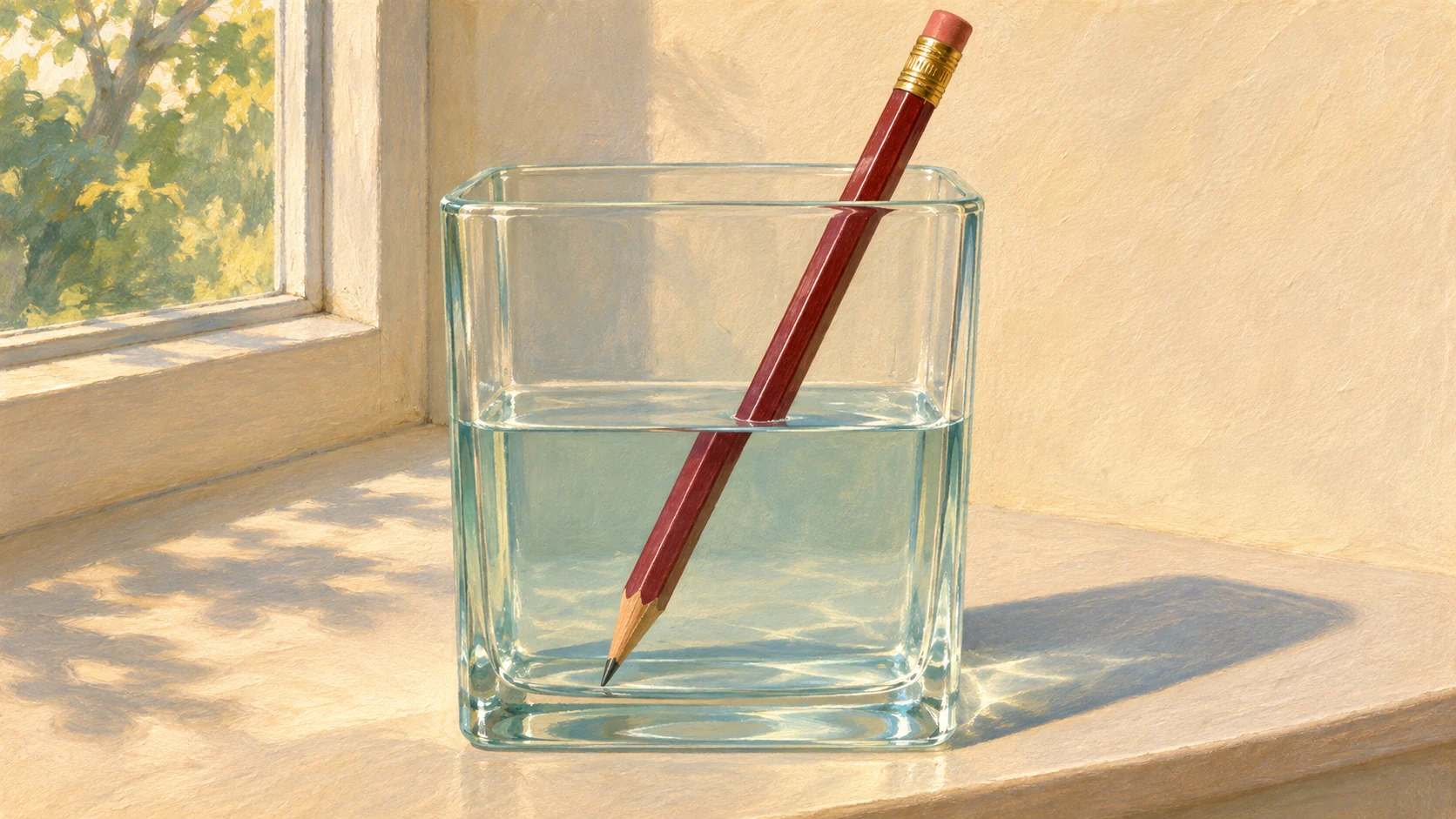
Put a straight pencil into a clear glass of water at an angle and look from above the side: the part under water seems to be shifted out of line at the water's surface. Take it out, and the pencil is still straight. Move your eye to another position, and the offset changes with it.
Where should the explanation begin? You can start by picking one pencil tip under water and asking how the light it reflects must travel to reach the eye. The optics section of eighth-grade physics is exactly about turning this kind of everyday observation, step by step, into a light path you can check.
Tracing light backward from the eye
Lesson 4 first covers light sources, shadows and reflection, then introduces imaging by a plane mirror. When you look at yourself in a mirror, what enters your eye is light reflected by the mirror's surface. Extend the reflected ray's direction backward behind the mirror, and you can locate the image on the diagram. Mark the object and the image, and you will see that they are symmetric about the mirror plane. Lesson 4, "Light Phenomena and Their Reflection and Refraction"
When working on this kind of problem, you can first mark the position of the eye on the diagram, then draw which ray can travel via the mirror to reach it. Even if you cannot yet calculate the angles, the diagram still helps you check whether you have drawn the direction of light backward.
At the water's surface, the direction of light changes
Light reflected from the tip under water bends as it passes at an angle from water into air. The eye receives the refracted light and traces it back along the incoming direction, so the tip appears in a position that differs from its actual position under water. Lesson 4 uses a similar light path to explain why the bottom of a clear pool looks shallower when viewed from above the water.
To see it more clearly, you can set the glass and pencil down steadily, keep the water level unchanged, and observe from two different angles, drawing the position where the tip appears each time. Then make a simplified sketch that keeps only the tip, the water surface and the eye. When you draw up to the water surface, first draw a normal line perpendicular to the boundary, then check whether the angle of refraction is larger than the angle of incidence as the light leaves the water at an angle and enters the air.
Put refraction onto a piece of glass with a curved surface
Lesson 5 carries this idea into lenses. A convex lens is thick in the middle and thin at the edges, and light parallel to the principal axis converges after being refracted by it. The courseware moves from the shape of the lens to the principal axis, focal point and focal length, then on to optical instruments that use several lenses to change what we see. After drawing a single bend at the water's surface, you can look at the path of light before and after it passes through a lens and follow each segment of light to understand where the focal point comes from. Lesson 5, "How Lenses Work and the Exploration of the Universe"
After observing, add a diagram that explains the phenomenon
This Simplified Chinese course is intended for eighth-grade students and also covers topics such as mechanical motion, sound phenomena, changes of state and mass. When you learn physics by starting from a question from daily life, you can first note down what you see, then change one observing condition, and finally explain the change with a diagram or a measurement. The first practice diagram in the optics section could be that pencil in the glass. Try pointing it out to a classmate: where does the light bend, and where does the eye see the tip? Enter the PHYS801A-PEP-CN course