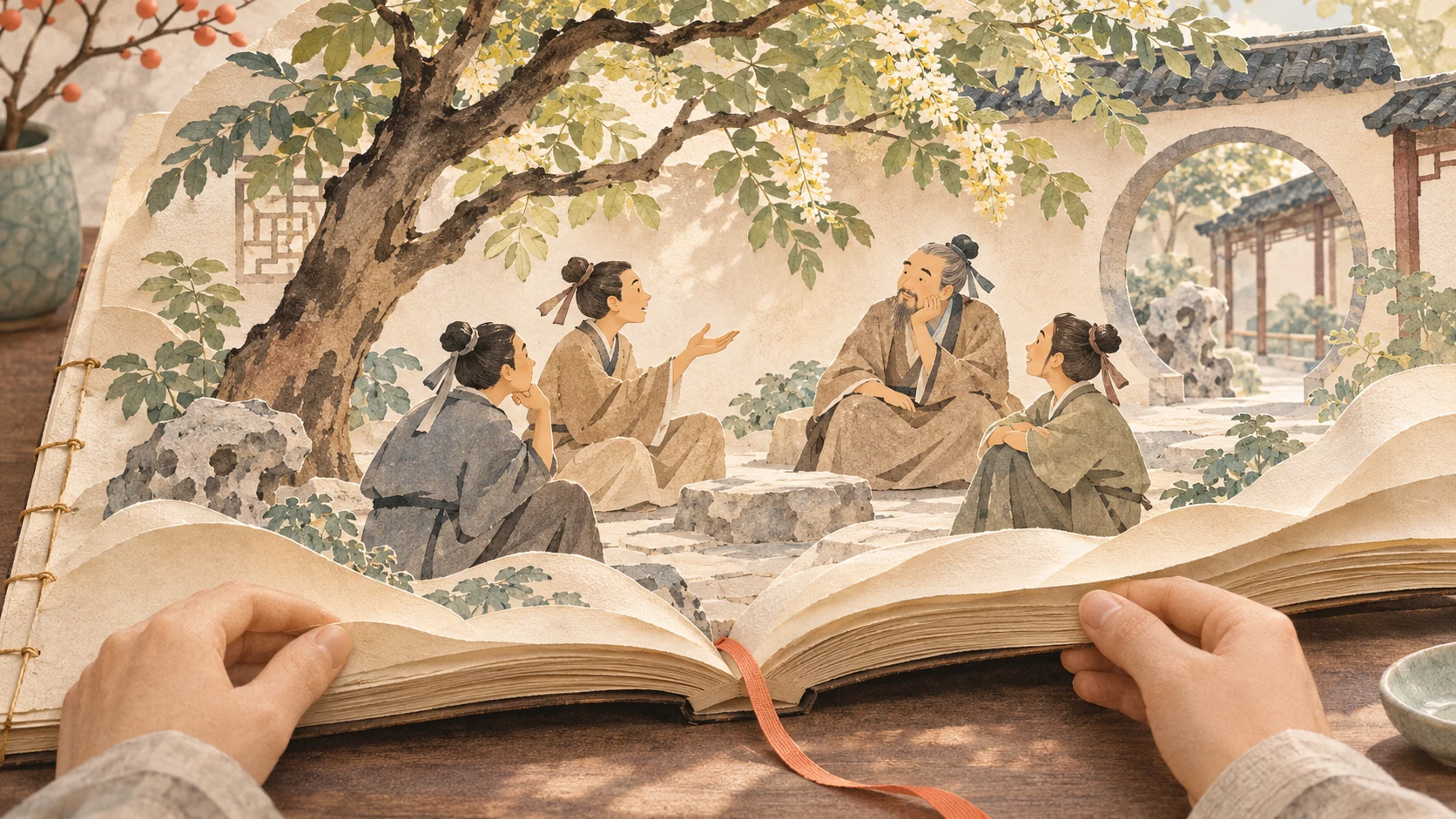
Imagine you are reading the Analects and come to Fan Chi asking about ren. Confucius answers, "Love others." You jot in the margin: ren means caring for other people.
Reading on, you meet Yan Yuan asking about ren, and the answer is different: "To restrain oneself and return to the rites is ren." The same question, but this time it concerns disciplining oneself and the demands of ritual propriety.
Set the two passages side by side, and your once-neat note needs a few more lines: What does each one emphasize? What comes before and after? And what would be lost if you remembered only one of them?
The entry point for rereading a classic often lies in just such a pause.
EvoClass's PHIL006, Selected Readings from the Analects: Confucian Thought and Classic Passages, links four lessons into a sequence: an introduction to the text, ren and ritual propriety, learning and the junzi, and governance together with the text's later transmission. Running through it all is one reading path: first identify the material, then enter its context, and finally explain your own interpretation.
First, let a single line become a conversation again
When a famous saying appears alone on the page, it often looks complete and settled. But back in the book, it may be only one part of a particular exchange.
Lesson 1, "What Kind of Book Is the Analects?" begins with the characteristics of the sayings genre and reminds readers to identify the speaker, the questioner and the related chapters. Material on the same theme may be scattered across different books and needs to be read together and compared.
So when reading "love others," you can first keep Fan Chi's question and the dialogue that follows; when reading "restrain oneself and return to the rites," you should also keep watching how Yan Yuan presses further and how Confucius responds. Both passages can be found in the Analects, "Yan Yuan".
A suitable exercise for beginners is to copy the two complete passages side by side on paper, mark who is asking and who is answering, and circle the different words used in the answers.
First write down observations: one passage concerns relations between people, the other concerns how to make demands on oneself. Then try to explain whether the two can complement each other.
This also makes us notice the limits of reading. Details of the scene that the original text does not supply can be left blank for now; judgments about people's temperaments and the intent behind an answer need to be supported with reasons. Reading a dialogue concretely does not mean inventing a touching story on the ancients' behalf.
When "love others" enters daily life, things become concrete
Understanding a translation of a line still may not tell you what it has to do with you.
Lesson 2, "Ren: From Loving Others to Fulfilling Oneself" places the discussion of ren within human relationships and goes on to distinguish ren and ritual propriety, loyalty and reciprocity, and the difficulties of putting them into practice.
You can construct a discussion scenario from today: a companion runs into a problem, you very much want to help, and so you decide their next step for them. But they say this is not the help they needed.
If you only write "be caring toward others" beside this experience, the problem has not been fully discussed. How is your goodwill expressed? Have you listened to the other person's wishes? Is it possible both to care about others and to restrain your urge to decide for them?
Such scenarios can help us raise questions, but they cannot directly serve as the standard meaning of a classical text. You still need to return to the passage and explain which words and phrases support your understanding, and which parts are extensions of thought belonging to today.
Reading and life thus move back and forth. A familiar line gains one more chance to be carefully discerned.
After you can explain, you also need to say how you understand
Now consider "Learning without thought is bewildering; thought without learning is perilous."
Translating it into a fluent passage of plain modern language easily brings this reading to a quick end. But if you want to use it to examine your own way of learning, the task becomes much more concrete.
Lesson 3, "Learning to Become Human: Learning and the Junzi" centers on learning and practice, learning and thinking, and the junzi personality. The relevant original text can also be read alongside the Analects, "Wei Zheng".
For example, after reading an explanation, first close the materials, write out your understanding in your own words, then return to the original to check: which statements have support, and which were filled in from memory? When you hit a word that is hard to explain, keep looking it up rather than rushing to smooth the question away.
You can also add three short columns to your reading notes: what the original text says, how I explain it, and what I have not yet figured out.
This is a learning arrangement worth trying. Its value lies in leaving traces of thought: the next time you reread, you can see where your understanding changed and why.
For teachers or parents reading together with children, this also offers a way to discuss. After hearing an answer, keep asking the other person to point out the basis, propose another interpretation, or say what they still have reservations about.
Bring the ancients' questions into today, and see the distance of the times
As the reading progresses, personal cultivation also extends to the relationship between individuals and groups, and between rules and example.
Lesson 4, "Governing by Virtue and the Transmission of the Analects" connects these discussions with the later transmission and commentary of the Analects, and also raises the question of how we should read it today.
For example, on reading a passage about rulers leading by example, you might think of responsibilities in a class or a team: do those who make the rules follow them themselves? And what conditions are needed for members' sense of self-discipline?
Such connections are worth discussing, but we should also see the differences between past and present. Status relations and institutional backgrounds in ancient times differ from those of today's classes or organizations. A similar situation can help us open up a question; whether a modern arrangement is appropriate and effective still needs to be judged in light of real-world conditions and evidence.
The classic thus leaves room for continued conversation. Readers can understand a claim, raise doubts, or state how far they agree.
If you would like to start again from a few familiar passages, you can visit the PHIL006 course overview and begin by choosing one exchange, completing a small act of comparative reading: keep the surrounding text, identify the speakers, then write down your own understanding and questions.
Return to those two words from the beginning—"love others"—and they have not become unfamiliar.
What has changed is that you are now willing to leave a few more lines beside them, carefully noting why you understand them as you do.
The course description is based on the current four lessons of EvoClass, and the lesson links lead to Simplified Chinese materials. The reading exercises, peer support and shared-reading arrangements in this article are teaching scenarios or reading suggestions, not user case studies or records of learning outcomes. Citations of classical texts are based on the original sources; discussions set in modern situations are not presented as the only interpretation.