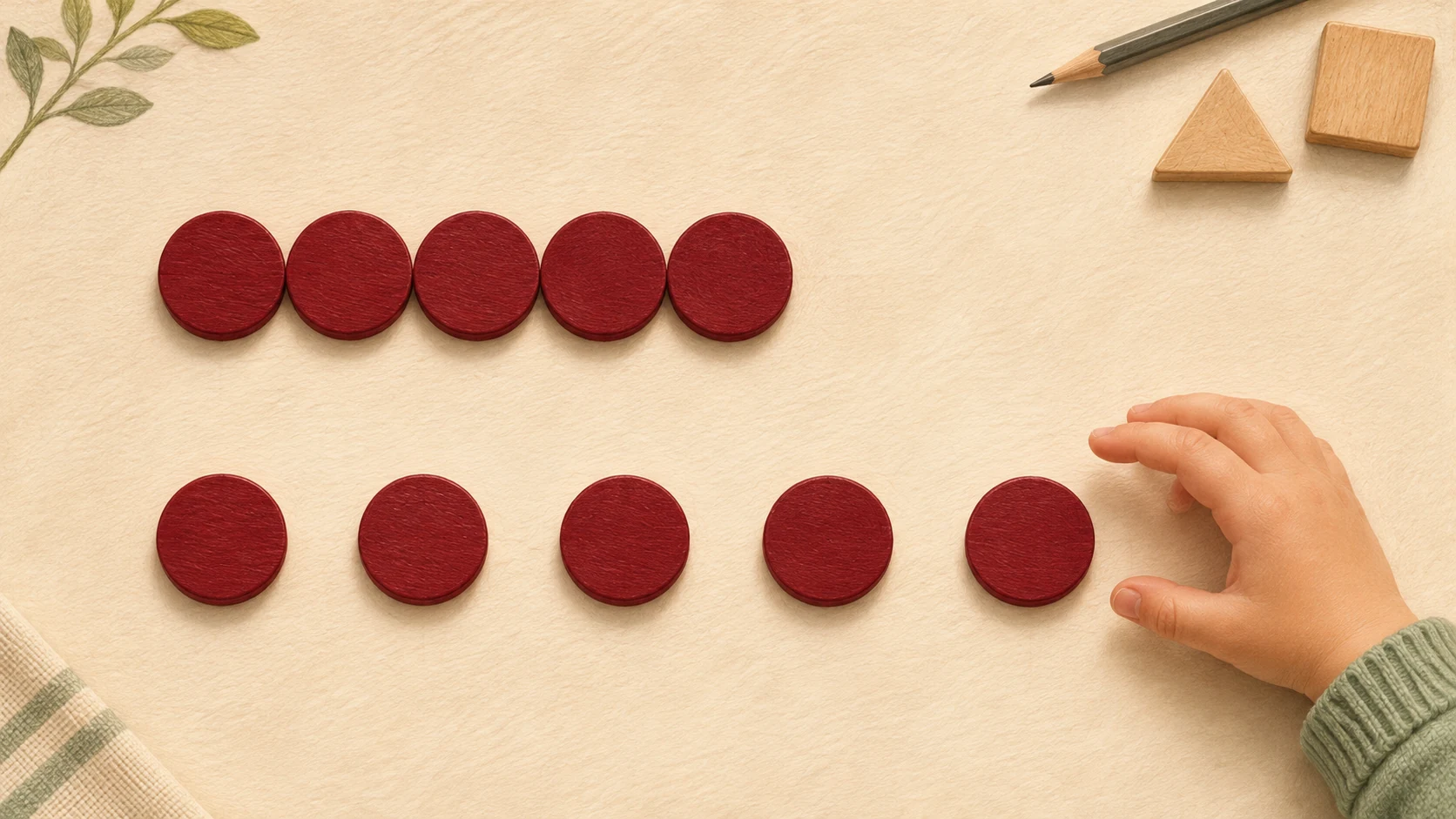
Set out two rows of counters on a table, five in each row, lined up one above the other. Then slowly spread the bottom row apart.
If you now ask "which row has more," a child may point to the longer row. They were the same just a moment ago—so why does the answer change when the counters simply move?
Don't rush to push the counters back together, and there's no need to announce the correct answer right away. You can invite the child to count again, or to match the counters in the two rows one to one. Nothing was added and nothing was taken away; what changed is the spacing, and the quantity is still five.
This small moment opens a very concrete entry point into early math: what the eyes see and what can be verified by counting sometimes offer different clues. Children can find the reasons through their own actions.
EvoClass's MATH000 Preschool Math Foundations is organized around five themes: number sense, space and geometry, sorting and patterns, measurement, and time. The course offers gamified lesson materials and practice activities for parents and teachers to explore step by step alongside their children. The learning process it cares about is also hidden between those two rows of counters: how do we move from "it looks this way" to "I have a way to find out"?
After counting to five, you still need to know what "five" means
Saying "one, two, three, four, five" smoothly and counting five objects on a table require somewhat different actions.
A child may recite quickly while their finger skips a counter; or they may touch the same counter twice and end up with a different number. At that point, slowing down and matching one number word to one object is closer to the problem at hand than continuing to recite numbers further.
In Lesson 1's number sense and conservation of quantity materials, the course unfolds the order of counting, one-to-one correspondence, cardinality, and conservation of quantity step by step. The "stretching" scenario is exactly about observing whether the quantity changes after the same group of objects is spread out.
After counting, you can also pause and ask: "So, how many are there altogether?"
The final "five" represents the quantity of the whole group. Start counting from a different point, or arrange the counters in a circle—as long as each counter is counted once, the total can still be verified.
This kind of pause connects number words with the things in front of the child. It also gives the child another way to handle disagreement: if two people see things differently, they can arrange the objects, match them up, and count again.
How many relationships can one box of blocks hold?
Once quantity is clear, there is still plenty on the table worth observing.
A block can be red, and it can also be square. Grouping by color and grouping by shape produce different sets. Asking a child to explain "why are these in a pile together" lets you hear which criterion they used.
MATH000's geometry theme moves from flat shapes to solid shapes and building; the sorting and patterns theme keeps asking how relationships between objects are established. After recognizing a shape, a child can turn it, fit pieces together, and observe how it looks in different positions and combinations.
By Lesson 3's sorting and patterns materials, observation gains another layer: in a sequence, which small segment is the one repeating?
For example, you can use large shape tiles that are easy for children to handle to lay out "circle, square, circle, square." Ask the child to add the next piece, then use a hand to circle the repeating "circle, square" unit. Then deliberately swap in a wrong piece and see how they fix it.
If the child only says "this part is wrong," an adult can follow up: "How do you think it should be arranged?" Being able to point out one change is already a starting point for explaining a pattern.
"Longer" and "more" turn out to be separate judgments
Now back to the two rows of counters from the beginning.
The spread-out row has not increased in quantity, but the distance from end to end has grown. So a question that was originally only "which has more" splits into two questions that can be discussed separately: how many, and how much space it takes up.
The course's measurement theme brings this kind of comparison into everyday objects. In Lesson 4's comparison and measurement materials, aligning starting points, placing units end to end, using string to compare fixed objects, and measuring with non-standard units such as blocks are all concrete exploration activities.
When accompanying a child, try a small experiment with two pencils: first lay them out offset from each other and ask the child which is longer; then align one end and see whether the original reasoning still holds.
Measuring the edge of a table with blocks raises new questions. If there are gaps between the blocks, can the recorded number still accurately represent the length? If one person uses large blocks and another uses small blocks, does the larger number necessarily mean a longer measurement?
Here, "how can we compare fairly" takes on a meaning that can be checked by hand: starting points must be aligned, units must be stated, and placement must be consistent.
None of these conditions need to be explained all at once. When a question arises during a measurement, resolve one point first and let the child see why their own method needs adjusting.
Bringing math back into the day
Time is harder to pick up and observe than blocks on a table, yet it is just as connected to children's experience.
MATH000's final theme covers the order in which things happen, clocks, duration, and daily schedules. Order and how long something lasts offer two different directions for observation: putting on shoes comes before going out; putting blocks away may take a while.
Parents or teachers can first have the child arrange picture cards of their morning, then choose a short activity to feel what one minute is like. Waiting quietly for a minute and being busy building for a minute may feel different; a timer offers another record that everyone can refer to together.
Starting from the MATH000 course page, there's no need to rush all five themes into a progress chart. You can pick the lesson that interests the child most right now, watch a segment of the materials, then return to the table, the room, or the day's schedule and try to find a similar question.
A single activity also doesn't need to produce a full set of conclusions. Being able to say "I matched them up one to one," or to suggest on their own "let's align the two ends first," gives you something worth discussing further.
When the child looks again at those two rows of counters, they may still want to count them once more. That's good. What math leaves here is a method that can be taken out and used at any time: when things look uncertain, check by doing.
This article is based on EvoClass's current MATH000 course description and lesson materials; the family extension activities described here are examples to support understanding and shared learning. The lesson links point to English-language materials, and parents or teachers are encouraged to read, retell and work through them with their children, using appropriately sized and safe materials. Visitors can browse the lesson materials; full features such as the AI tutor require signing in.