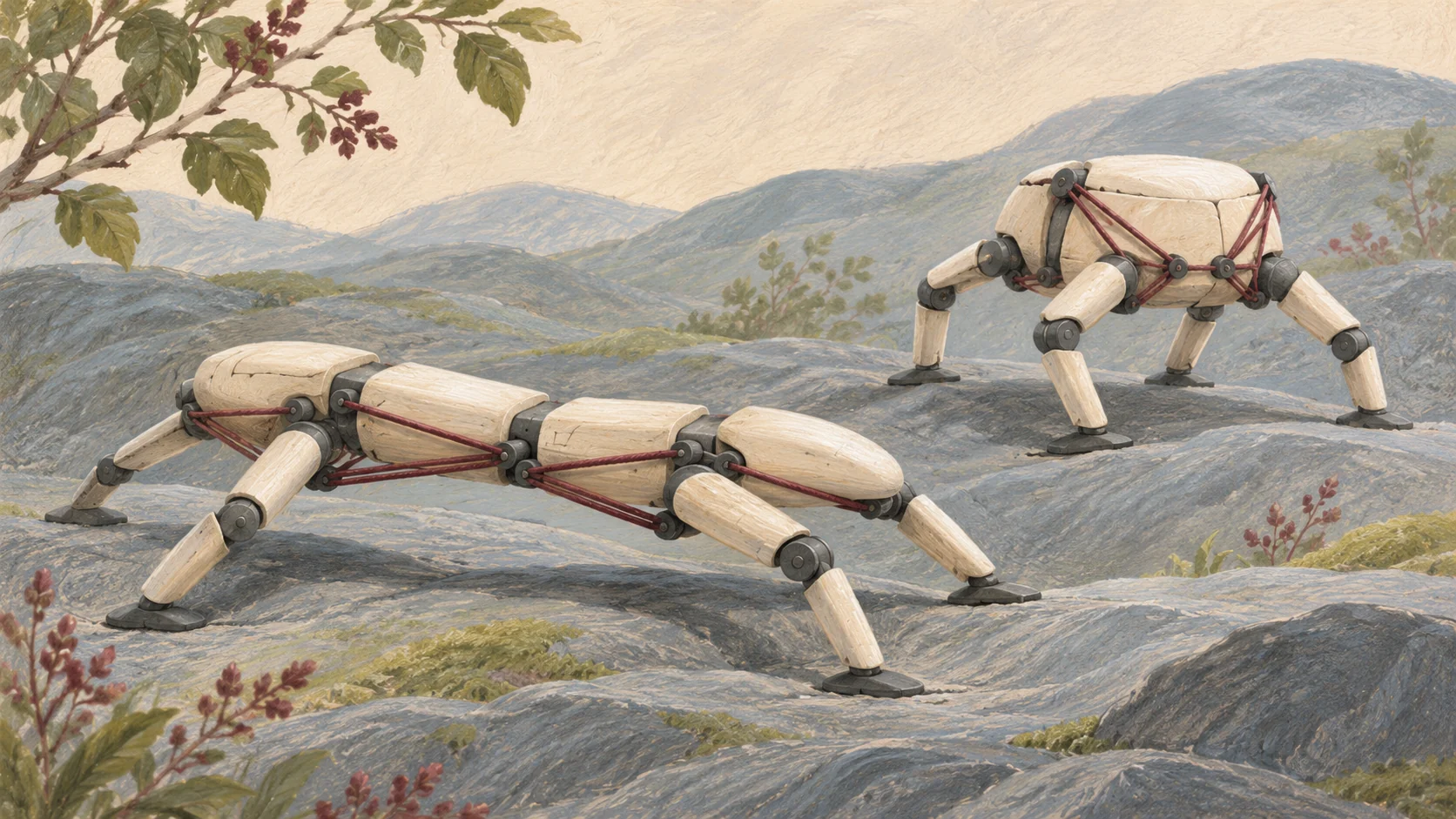
Imagine a simple simulation experiment: a controller sends signals at the same rhythm, but the body of the locomotion model is made longer, or its joints are made softer. The input does not change, yet the resulting movement may not be the same.
This thought experiment points to something easily overlooked: the production of movement involves not only control signals, but also the body that receives those signals and the environment it contacts.
EvoClass's AI009L "Evolutionary Computation and Applications of Neural and Morphological Developmental Systems — A New Path Toward Artificial General Intelligence" places this set of relationships on a single learning path. The course is organized around themes from the relevant work of Yaochu Jin, discussing evolutionary algorithms, developmental models, neural plasticity, and the joint changes of brain and body. What it presents is a set of research questions and modeling methods; it should not be understood as a conclusion that artificial general intelligence has already been achieved.
A movement involves control, body and environment
When we watch a model move forward, it is easy to ask only what command the controller "issued." But the body's mass, the way its parts are connected, and its elasticity also affect how those commands become movement.
The materials for Lesson 10, "Co-evolution of Neural and Morphological Systems", include spring–mass–damper models, central pattern generators, and the mutual dependence of neural control and physical properties.
These concepts each do different work: a physical model describes how the body moves and responds; a rhythmic control model describes how signals change over time; only by connecting the two can we examine how a particular movement is produced.
So "the body participates in intelligence" does not mean that the body hides another mysterious decision-maker. It asks us to complete the explanation: which behaviors come from control, which depend on structure, and which appear only through interaction with the environment?
When the body can also change, there is more than one objective
If a designer fixes the body in advance and searches only for suitable control parameters, that explores one class of problems. Allowing body morphology and control to change together also changes the search space and the evaluation criteria.
Does running faster mean consuming more resources? If a certain morphology performs exceptionally well in one environment, does it still work under different conditions? If only the single best-performing candidate is kept, might another, more robust option be overlooked?
The evolutionary optimization material earlier in the course provides the methodological basis for these questions; Lesson 10 then places multi-objective trade-offs back between locomotion performance and morphological constraints. Understanding this connection helps clarify what "co-evolution" means: evaluating a candidate requires observing both its composition and the behavior that arises from it.
At this point, you can leave yourself a small table: what variables are allowed to change, what conditions are held fixed, and how results are evaluated. The parts you cannot fill in clearly are often the experimental assumptions you have not yet understood.
From one body to morphologies formed by many individuals
The later part of the course shifts the scale of observation further.
In Lesson 12, "Morphogenetic Self-Organization of Swarm Robots", the subject turns to local interactions among multiple robots. Subsequent lessons discuss boundary coverage, area coverage, and self-organization models related to the diffusion of morphological factors.
What is worth asking here: when the information available to each individual is limited, how does the group form a relatively stable spatial structure? When local rules change, how does the overall morphology respond?
"Self-organization" also does not mean there are no conditions. Individual rules, modes of interaction, the environment and initial settings still matter. After observing a swarm pattern, one should also check whether it persists under perturbations and changing conditions, rather than looking only at a single successful snapshot.
First see the model clearly, then discuss what it can show
AI009L is better suited to readers willing to engage with evolutionary computation and mathematical modeling. If you are not yet familiar with these tools, you can start with Lesson 1, "Natural Evolution and Evolutionary Algorithms" to build basic concepts before moving on to the co-evolution section. The course is currently presented in Simplified Chinese.
From simulation to real systems, one still has to deal with materials, perception, control error and environmental variation. The models in the course help us pose testable questions; they do not automatically remove these gaps.
Returning to the opening thought experiment about changing the body: what is truly worth comparing is not only "did it move faster," but also why the result changed and which conditions brought about the change. Explaining these relationships clearly is a more solid starting point for understanding embodied intelligence.